
Showing posts with label history. Show all posts
Showing posts with label history. Show all posts
Tuesday, July 15, 2014

Monday, July 14, 2014

Saturday, October 19, 2013
Sydney trains website
It's probably going to change on 20 October 2013. Here is a screenshot of how it was before it changed.


Monday, May 13, 2013

Tuesday, March 26, 2013
Timetable Tuesday- 1988 Bankstown Line
Howdy, has it really been 6 months? I thought I'd belatedly click off 2013 with the Bankstown Line, 1988, which is the oldest Bankstown line 'table I can find in my dusty old box. I may find an earlier one if I dig a bit harder, we'll see.
Anyway, there are a few interesting titbits and curiosities to be found.
The cover is in the style of the time, printed in 2 tone, non glossy paper.

Not much introduction inside, just a promo.....

Straight to the weekday timetable. Arranged in two rows. First thing to note is that this predates regular LIverpool- city via Bankstown services. Most services do the loop, or start at Bankstown. Also, Bankstown had a better peak hour service in 1988 than today- 16 services departed Bankstown between 7am and 9am compared to 11 today.


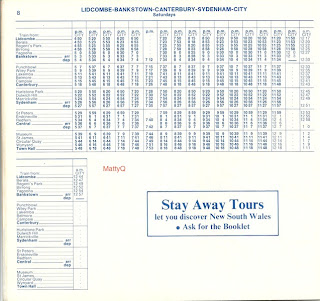
On weekends, a 30 minute frequency, with an odd extra thrown in occasionally.

Punchbowl depot was open then, which presumably is where some of these services head to.

And behold, the famous Penrith- Cronulla service on summer Sundays.

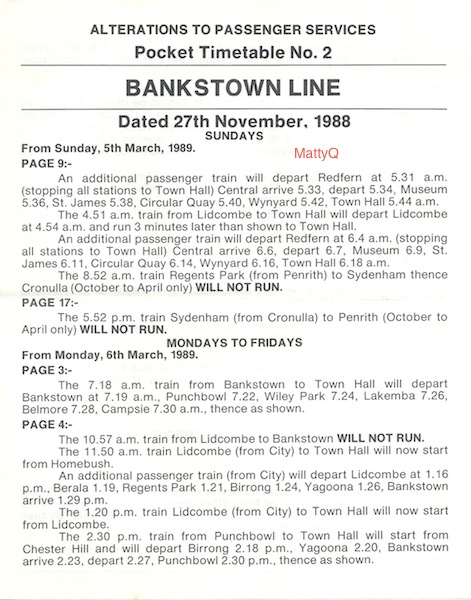
But it was not to run for long. Maybe 1988 was more frugal- but when timetable changes were to be made, let's not reprint the whole thing but add in a loose leaf page of amendments to sift through. I guess it was pre- internet and all. The Penrith- Cronulla service was deleted in November 1988. I'll have to see if I can find a 1988 Illawarra and/or Western line table to see the rest of it.

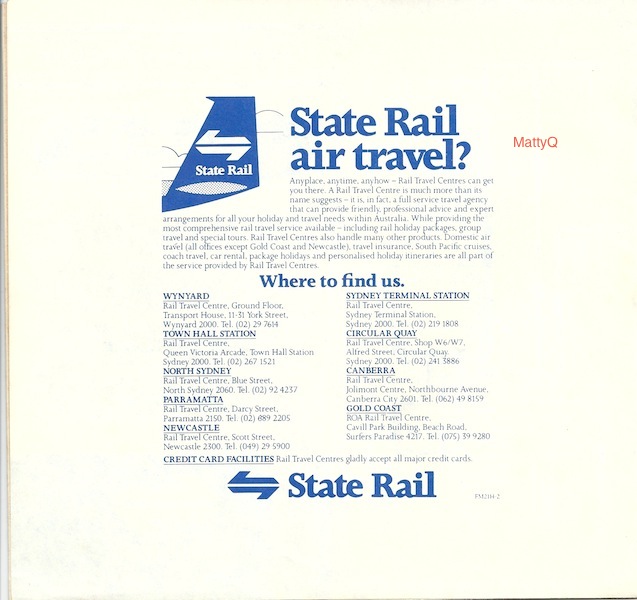
Travellers aid 1988 style....

Info is on the back cover.
 See you in another 6 months?
Anyway, there are a few interesting titbits and curiosities to be found.
The cover is in the style of the time, printed in 2 tone, non glossy paper.

Not much introduction inside, just a promo.....
Straight to the weekday timetable. Arranged in two rows. First thing to note is that this predates regular LIverpool- city via Bankstown services. Most services do the loop, or start at Bankstown. Also, Bankstown had a better peak hour service in 1988 than today- 16 services departed Bankstown between 7am and 9am compared to 11 today.


On weekends, a 30 minute frequency, with an odd extra thrown in occasionally.

Punchbowl depot was open then, which presumably is where some of these services head to.

And behold, the famous Penrith- Cronulla service on summer Sundays.

But it was not to run for long. Maybe 1988 was more frugal- but when timetable changes were to be made, let's not reprint the whole thing but add in a loose leaf page of amendments to sift through. I guess it was pre- internet and all. The Penrith- Cronulla service was deleted in November 1988. I'll have to see if I can find a 1988 Illawarra and/or Western line table to see the rest of it.
Travellers aid 1988 style....

Not sure if I'd use a travel company with this name....

Info is on the back cover.

Friday, August 17, 2012
21st birthday, Richmond electrification.
Happy birthday Richmond electrification, you turn 21 today! On 17 August 1991, the Riverstone- Richmond section of the Richmond Line saw electric trains introduced. Three 2 car L-sets provided shuttle services between the two stations, providing connections to through trains to the city from Riverstone. A shuttle arrangement was necessary because power supplies were initially inadequate to allow more than one 8-car train north of Riverstone at any one time, surely a strange set of affairs for a new electrification project, however the initial project did not include platform lengthening to a full 8- car length, so the 2 car shuttles simply plodded along to the same timetable as the 2-car diesels that operated previously. The line had been served by fairly dilapidated 2 car 600 class trains, two sets of which were shunted off to the Hunter after their time had finished on the Richmond Line.
The electrification of the Richmond line had a long gestation, with the section to Riverstone electrified in 1975 and seemingly little thought about doing the rest until some masts appeared in the mid 1980's. The newly elected Greiner government in 1988 halted the (slow) work, until work restarted in March 1991, with completion by August. It took another year or so until power supply and platform lengthening allowed 8-car running from Richmond through to the city.
The electrification of the Richmond line had a long gestation, with the section to Riverstone electrified in 1975 and seemingly little thought about doing the rest until some masts appeared in the mid 1980's. The newly elected Greiner government in 1988 halted the (slow) work, until work restarted in March 1991, with completion by August. It took another year or so until power supply and platform lengthening allowed 8-car running from Richmond through to the city.
Tuesday, May 22, 2012
Timetable Tuesday- 1990 Central Coast Line
The counterpart to the 1990 'Newcastle Area' timetable discussed last Tuesday was the 'Central Coast Line' timetable. This timetable combined Northern Line suburban services with services up the Central Coast through to Newcastle, but excluded "local services' between newcastle and Fassifern (and the Toronto branch line). Therefore it carried the note that it didn't show all services between Fassifern and Newcastle)
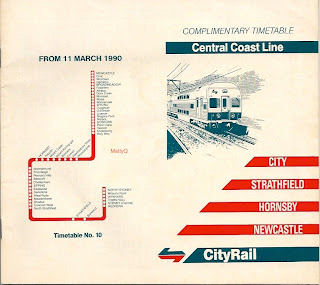
The basic Central Coast portion of the timetable consisted of hourly 'fast' services between Newcastle and Sydney, with an additional slower hourly 'all stations' service. The express service overtook the preceding all stations service at Gosford, with with a 11 minute (down trains) or a 17 minute (up trains) pause of the slow service at Gosford to allow the pass to occur. This was supplemented by a few weekday peak hour Gosford, Morisset and Wyong starters. Only one morning peak service from Gosford operated via the North Shore, all others operated via Strathfield and terminated at Sydney Terminal. On weekends, the slow interurbans served the stations between Cowan and Berowra. Also Interurbans stopped at Eastwood rather than Epping.
So essentially all stations on the Central Coast line received at least an hourly service on all days. This is a more favourable service compared with todays weekend timetable north of Wyong.

 The suburban portion detailed services between Hornsby and Central via Strathfield The present 'Northern Line'. Suburbans generally started at Hornsby with about a 15 minute frequency in peak hours consisting of a mixture of all stations and limited stoppers, and a half hourly frequency off peak and weekends. A mixed bag of mainly peak hour additional services started or terminated at Epping. Suburbans between Berowra and Hornsby operated via the North Shore, and were shown in the timetable with the annotation 'via North Shore'.

The basic Central Coast portion of the timetable consisted of hourly 'fast' services between Newcastle and Sydney, with an additional slower hourly 'all stations' service. The express service overtook the preceding all stations service at Gosford, with with a 11 minute (down trains) or a 17 minute (up trains) pause of the slow service at Gosford to allow the pass to occur. This was supplemented by a few weekday peak hour Gosford, Morisset and Wyong starters. Only one morning peak service from Gosford operated via the North Shore, all others operated via Strathfield and terminated at Sydney Terminal. On weekends, the slow interurbans served the stations between Cowan and Berowra. Also Interurbans stopped at Eastwood rather than Epping.
So essentially all stations on the Central Coast line received at least an hourly service on all days. This is a more favourable service compared with todays weekend timetable north of Wyong.
Weekday example:

Weekend example:

Tuesday, May 15, 2012
Timetable Tuesday: 1989- Newcastle Area
In 1990, the Toronto branch line in the Newcastle area closed. The Toronto line was a single track line which branched from the Main North at Fassifern, and served the lakeside town of Toronto, with one intermediate station- Blackall's Park. Toronto station still exists, reasonably well preserved.
The October 1989 timetable is the last timetable which included this line. The running time for the branch was 6 minutes, and remarkably an approximately 20 minute frequency was maintained on the line, even on weekends. Every 2nd or so train connected with services to Newcastle or Sydney.
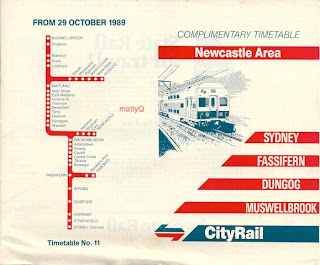
The timetable was also formatted in such a way that the some Toronto branch services appear in the same column as the main line service (you will see what I mean in the examples of the timetable).
This was also the last CityRail timetable to feature the Brisbane Limited and the Pacific Coast Moto-rail prior to their replacement by XPTs.

Also, Hilldale and Wirragulla stations were not served, and CityRail services ended at Muswellbrook (i.e. they didn't make it to Scone). There were the same number of weekday services past Telarah as today- 4 to Muswellbrook and 5 to Dungog. Weekend frequency was the same as today but different timings.
The frequency of services between Telarah and Newcastle was about the same as today, but in 1989 services stopped at all stations giving a half hour frequency for all intermediate stations, compared to an hourly frequency at smaller stations today with the current pattern of alternate limited stops services.

Note also that the map has a gap between Singleton and Branxton. I'm not sure what station was previously there. Belford was served for a while after 1990, but there are a couple of other possibilities: Whiitingham?, Minimbah? Warabrook and Metford hadn't opened then either- they debuted in 1995.

The October 1989 timetable is the last timetable which included this line. The running time for the branch was 6 minutes, and remarkably an approximately 20 minute frequency was maintained on the line, even on weekends. Every 2nd or so train connected with services to Newcastle or Sydney.

The timetable was also formatted in such a way that the some Toronto branch services appear in the same column as the main line service (you will see what I mean in the examples of the timetable).
This was also the last CityRail timetable to feature the Brisbane Limited and the Pacific Coast Moto-rail prior to their replacement by XPTs.

Also, Hilldale and Wirragulla stations were not served, and CityRail services ended at Muswellbrook (i.e. they didn't make it to Scone). There were the same number of weekday services past Telarah as today- 4 to Muswellbrook and 5 to Dungog. Weekend frequency was the same as today but different timings.
The frequency of services between Telarah and Newcastle was about the same as today, but in 1989 services stopped at all stations giving a half hour frequency for all intermediate stations, compared to an hourly frequency at smaller stations today with the current pattern of alternate limited stops services.

Note also that the map has a gap between Singleton and Branxton. I'm not sure what station was previously there. Belford was served for a while after 1990, but there are a couple of other possibilities: Whiitingham?, Minimbah? Warabrook and Metford hadn't opened then either- they debuted in 1995.
Friday, May 11, 2012
The East Hills Timetables part 3- Glenfield extension 1987
In 1987, the extension between East Hills and Glenfield on the Main South line opened. It was soft opening to a degree, in that services operated along the extension only during weekday peak hours initially. The timetable was essentially the same as pre opening, with some tweaking to accommodate the new services. 3 services traversed the extension in the morning, with 3 retuning in the afternoon. There were no services on Sundays or public holidays.


Sorry that my copy of the timetable is a bit tatty. For some reason I can't upload the cover, will try again later.
Saturday, January 21, 2012
Tangara- 21st Century travel years ahead of its time
It won't be long before the first of the Tangaras are 30 years old. With the arrival of the Waratah trains, its interesting to reflect on the promotion of the Tangaras when they were about to be introduced, in particular the championing of the Australian made components. A contrast to today when the partially Chinese built Waratahs are almost embarrassingly slipped into service.

A word from our leader (the other Barry)....

The mockup, note the desto....


Some bits ended up looking a bit different....
Companies were proud to be associated- BHP, Mitsubishi Electric Australia and of course Goninan.
Heres a pic of the stainless steel construction....

And finally propaganda from the government on how well they are doing, note the Maldon-Dombarton line.

Monday, November 14, 2011
1988 Rosebery District UTA timetable
The Urban Transit Authority was created in 1980 when the Wran Government split the all encompassing Public Transport Commission (PTC) into the State Rail Authority (SRA) for trains and the UTA for buses and ferries. In 1989, the Greiner Government renamed the UTA the State Transit Authtority (STA) to which it remains today.
This is the last UTA timetable for the Roseberry District, encompassing routes 343, 345 and 351. 343 and 345 soldier on pretty much as they did. 351 was a peak hours only 'industrial' route between Kingsford and Redfern, now no longer.
Note the bicentennial logo bottom right of the cover.


This is the last UTA timetable for the Roseberry District, encompassing routes 343, 345 and 351. 343 and 345 soldier on pretty much as they did. 351 was a peak hours only 'industrial' route between Kingsford and Redfern, now no longer.
Note the bicentennial logo bottom right of the cover.


Sunday, November 13, 2011
The East Hills line timetables- Part 2, 1987- (Part 1!)
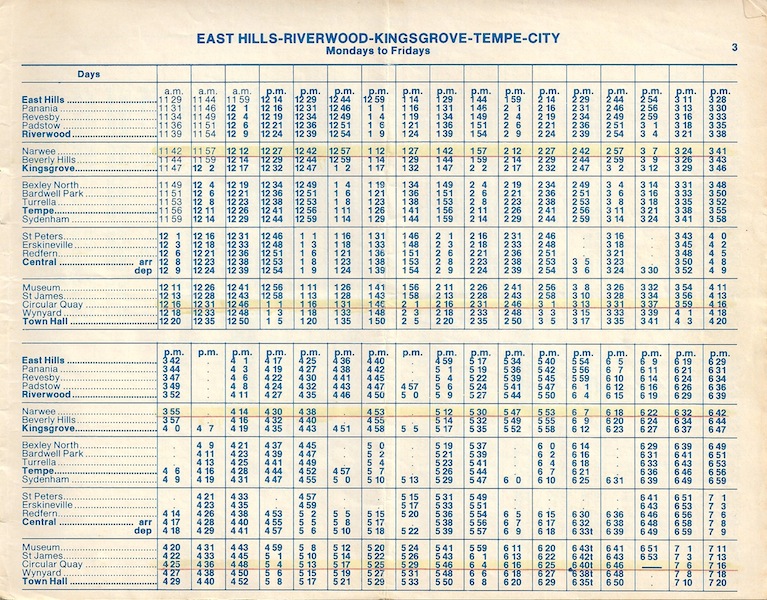
This timetable, dated 31st May 1987, is the last timetable prior to the opening of the extension to Glenfield. It's also in a new style. I must admit that of all the timetables published before and after, this style is my favourite. There is something about the snaky coloured line on the front with the major station names, and the 'East Hills Line' title in the format of the station signs of the time that screams 1980s. Perhaps its also that I was 14 at the time and it's probably my earliest real memory of carrying one of these things around.
The map is also my favourite of all the styles of State Rail/ CityRail maps published before and after. I've pointed out it's flaws on my website before, especially the ambiguous junctions at Blacktown and Cabramatta, but despite this it remains simple, clear and kinda funky. I also have fond memories of the perspex maps on the carriage walls above the side windows in the S and R sets (and can recall ripping a few off in a miss-spent youth).

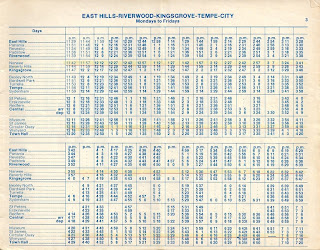
Anyway, into the timetable we go, and its basically the 1985 timetable tweaked a bit, with a few curiosities. The basic 15 minute clock face timetable remains, along with the few weekday peak hour limited stops runs, most of which have had their stopping patterns slightly adjusted. There are also a few services that terminate at Central with an asterix beside the time but no explanation of what that means. Presumably it refers to the fact that they terminate in the country platform but we are left to speculate and the 'Explanation of Symbols' is of no assistance. There is also a 'Days' column across the top, despite it remaining quite blank all through the timetable.

And what do I see at 6:53pm on weekday nights? A St James terminator!
 The rear cover has lost the fares and phone number information, too bad if you need help. But here we see the start of political spin, a list of looming new trains and improvements- the XPT is coming, so are 520 (yet to be named) Tangaras. Not sure about the 140 luxury air-conditioned interurban carriages, maybe the once proposed Inter-Urban Goninan Tangara variant that never came off (more on this in another post). $2,500 million in upgrades etc, in 1987 dollars (whew!). $2,500 million sounds like so much more than $2.5 billion. It was of course the last days of Barry Unsworth.

The map is also my favourite of all the styles of State Rail/ CityRail maps published before and after. I've pointed out it's flaws on my website before, especially the ambiguous junctions at Blacktown and Cabramatta, but despite this it remains simple, clear and kinda funky. I also have fond memories of the perspex maps on the carriage walls above the side windows in the S and R sets (and can recall ripping a few off in a miss-spent youth).

Anyway, into the timetable we go, and its basically the 1985 timetable tweaked a bit, with a few curiosities. The basic 15 minute clock face timetable remains, along with the few weekday peak hour limited stops runs, most of which have had their stopping patterns slightly adjusted. There are also a few services that terminate at Central with an asterix beside the time but no explanation of what that means. Presumably it refers to the fact that they terminate in the country platform but we are left to speculate and the 'Explanation of Symbols' is of no assistance. There is also a 'Days' column across the top, despite it remaining quite blank all through the timetable.

And what do I see at 6:53pm on weekday nights? A St James terminator!

Next.... the opening of the Glenfield extension.
Friday, November 11, 2011
The East Hills line timetables, part 1- 1985
The East Hills line has perhaps seen the most changes over the last 30 years of any Sydney suburban railway line. As a humble backwater between its opening in 1931 until its first major extension in 1987, the line is now a fairly major trunk route and the quickest of the 4 ways to get from Campbelltown to the city.
In 1985, the line was double track between Tempe and Riverwood, and single track to the terminus at East Hills, with a passing loop at Revesby. It was electrified throughout, although initially so only to Kingsgrove on opening, extending to East Hills in 1939.
In 1985, the line was served mostly by local all stations services generally on a 15 minute headway. A perusal of the timetable reflects this, with a mostly 15 minutely service between 530am and 9pm, dropping to half hourly thereafter. The last outbound departure was 1241am from Town Hall to East Hills and 1246am from East Hills to the city, 7 days a week. There were, however, also early morning departures from Town Hall at 221am (except Sundays) and 331am from East Hills. These were the days before NightRide.
During the weekday morning peak, there were 4 'express ' type services each with slightly different stopping patterns, the first stopped at all the stations between East Hills and Kingsgrove then express to Sydenham, the second ran all stations from East Hills to Narwee then express to Sydenham; the other two ran all from East Hills to Riverwood, then Kingsgrove, then express to Sydenham. These were supplemented by 3 services starting from Riverwood (where the double track needed) and 3 from Padstow.
Of note also is that all trains except a few of the peak hours services stopped at Erskineville and St Peters, now the domain of the Bankstown Line only.
The evening peak also saw a mixed bunch of limited stopping services generally skipping the more lightly patronised stations between Tempe and Kingsgrove, supplemented by Padstow and Riverwood terminators in a similar manner to the morning peak, and one that terminated at Kingsgrove.
Saturdays and Sundays were a generally a clock face 1/2 hourly service, except for a couple of bonus services thrown in on Saturdays at what perhaps were thought to be busier times (e.g. an extra departure at 747am from Kingsgrove and extra departures from Riverwood at 940am and 451pm giving 15 minutely intervals at these times). All weekend services stopped at all stations.

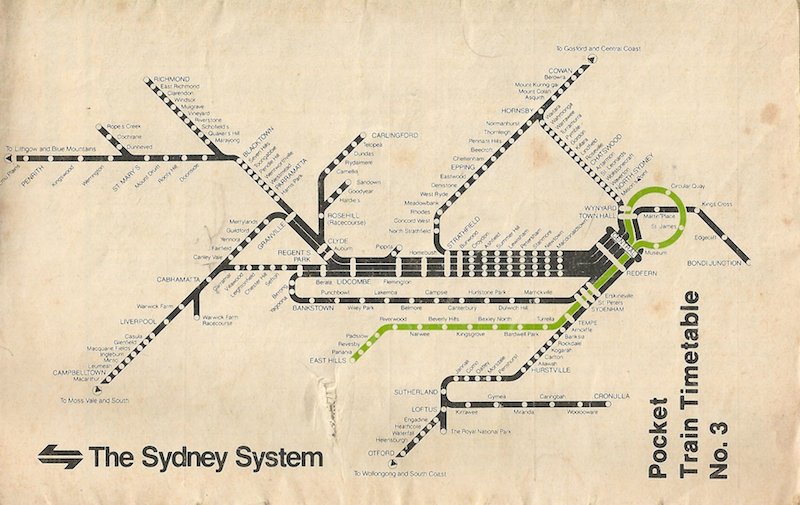
Stylistically, the timetable was branded as a product of "State Rail" (CityRail was yet to come into being), and the timetable was the last to feature the rather groovy angular 'The Sydney System' map. Timetables were also numbered, the East Hills line was 'Pocket train timetable no. 3"


In 1985, the line was double track between Tempe and Riverwood, and single track to the terminus at East Hills, with a passing loop at Revesby. It was electrified throughout, although initially so only to Kingsgrove on opening, extending to East Hills in 1939.
In 1985, the line was served mostly by local all stations services generally on a 15 minute headway. A perusal of the timetable reflects this, with a mostly 15 minutely service between 530am and 9pm, dropping to half hourly thereafter. The last outbound departure was 1241am from Town Hall to East Hills and 1246am from East Hills to the city, 7 days a week. There were, however, also early morning departures from Town Hall at 221am (except Sundays) and 331am from East Hills. These were the days before NightRide.
During the weekday morning peak, there were 4 'express ' type services each with slightly different stopping patterns, the first stopped at all the stations between East Hills and Kingsgrove then express to Sydenham, the second ran all stations from East Hills to Narwee then express to Sydenham; the other two ran all from East Hills to Riverwood, then Kingsgrove, then express to Sydenham. These were supplemented by 3 services starting from Riverwood (where the double track needed) and 3 from Padstow.
Of note also is that all trains except a few of the peak hours services stopped at Erskineville and St Peters, now the domain of the Bankstown Line only.
The evening peak also saw a mixed bunch of limited stopping services generally skipping the more lightly patronised stations between Tempe and Kingsgrove, supplemented by Padstow and Riverwood terminators in a similar manner to the morning peak, and one that terminated at Kingsgrove.
Saturdays and Sundays were a generally a clock face 1/2 hourly service, except for a couple of bonus services thrown in on Saturdays at what perhaps were thought to be busier times (e.g. an extra departure at 747am from Kingsgrove and extra departures from Riverwood at 940am and 451pm giving 15 minutely intervals at these times). All weekend services stopped at all stations.

Stylistically, the timetable was branded as a product of "State Rail" (CityRail was yet to come into being), and the timetable was the last to feature the rather groovy angular 'The Sydney System' map. Timetables were also numbered, the East Hills line was 'Pocket train timetable no. 3"
The only information provided, apart from the actual train times themselves, was what is shown on the rear cover (below): an explanation of (2) symbols, a list of commuter car parks, some basic fare information and some phone numbers. Note the 5 digit rail enquires number.

How does it compare to today? Well obviously service patterns are now completely different with the Glenfield extension and connection to the Airport line. The only useful running time comparison that can be made is for all-stations services between Revesby and Turrella, and its exactly the same- 19 minutes in 1995 and 19 minutes in 2011.
Next.... the 1987 timetables.
Monday, November 7, 2011
Kiama goes Electric! (10 years ago)


Subscribe to:
Posts (Atom)